In the winter of 1848, a prospecting party out of Monterey worked its way into the Sierra foothills and stopped where Angels Creek meets Dry Creek. Among them was Henry Pinkney Angel, a Rhode Islander. He was, by most accounts, a poor miner. What he was good at was noticing that several hundred men digging in a canyon all needed things, and none of them had anywhere to buy them.
So he pitched a tent and opened a store. He traded essentials for gold. Flour, tools, boots, tobacco, whatever a miner could not make himself. Local histories credit his brother George alongside him, and the two later ran a pack train to supply camps further out. The mining claim is a footnote. The store is the reason there is a town, and the reason it carries his name.
By December of 1848 an observer counted roughly a hundred miners working the vicinity, most of them doing well. By spring of 1849 the population had passed three hundred. Angel's tent had become the commercial center of a settlement that did not yet know it was one.
This matters more than it sounds. Hundreds of gold rush camps appeared and vanished inside a decade, and the ones that survived almost always survived for the same reason: somebody was selling something. When the easy gold in the creek beds was gone by 1850, the miners who left went looking for the next strike. The merchants stayed, because merchants sell to whoever is standing in front of them. Angels Camp kept its main street when other camps became meadows.
The stone years
1854 to 1902, when Main Street got permanentA quartz discovery in 1854 changed the economics completely. Hard rock mining meant shafts, mills, machinery, payroll, and permanence. The Winters and Davis vein alone is credited with somewhere between twenty and fifty thousand ounces of gold by 1865. Men who had been panning in a creek were now drawing wages, and wages get spent in town.
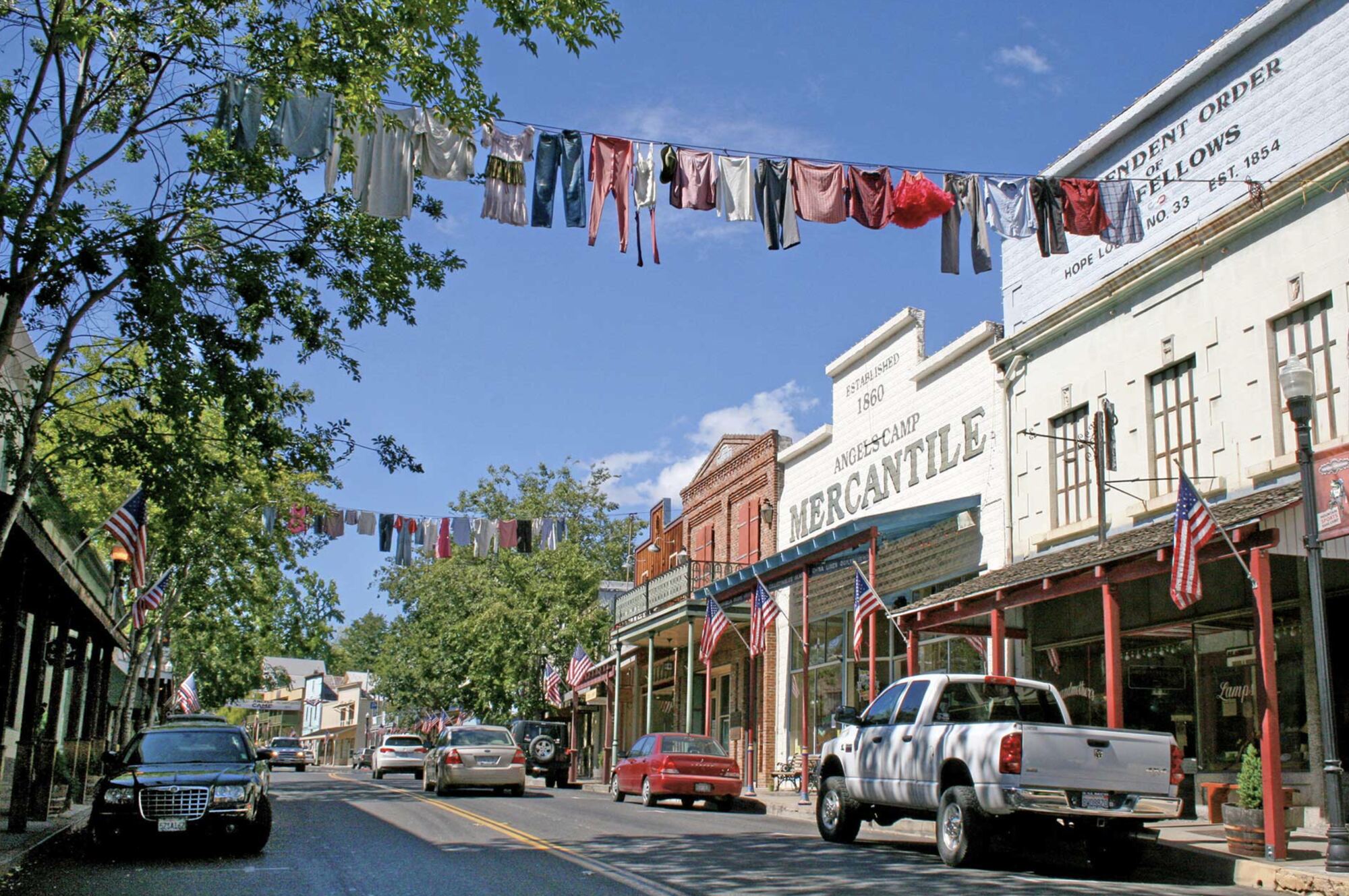
That is when the buildings stopped being wood. Fire took gold rush towns constantly, and the answer everywhere in the Mother Lode was the same: stone walls, iron shutters, iron doors. Walk Main Street in Angels Camp today and the buildings you are looking at are largely the ones that went up in this window, built by merchants who had decided to stay.
The people doing the building were not only Americans. The hard rock boom of the 1880s drew Serbian, Italian, French, Irish, and Chinese workers and their families into a town of a few hundred people. The 1890 census counted 917 residents, nearly triple the earlier figure. The surnames still on those storefronts, Largomarsino, Brosemer, Peirano, are the record of who actually built the commercial district.
The mercantiles
The buildings that are still standingAngels Camp's own walking tour identifies the commercial buildings and their dates. These are the ones that matter if you care about where retail in this town came from.
Henry P. Angel's Trading Post
Finnegan Lane. The first business in Angels Camp and the reason the town exists. J.C. Scribner bought the trade in 1849 and replaced the tent with a frame building, then a stone one on the same spot.
Peirano Store
Built directly in front of the Peirano and Lemue family home, in the pattern of the era where a family lived behind the business it ran.
Odd Fellows Building
Independent Order of Odd Fellows Lodge No. 33 met upstairs. Downstairs held a cigar store, a saloon, and dry goods, which is a fair portrait of what a mining town actually needed.
E. & G. Stickle General Merchandise
Yard goods and household items. The general store in its purest form, selling everything a household ran on.
Brosemer Building
Dry goods and mercantile, and recorded as the first store in town to do business on a cash basis rather than credit or gold dust. A small line that marks the moment Angels Camp became a real economy.
Largomarsino Brothers Mercantile
Stone construction with iron doors, and reportedly the oldest building in town. Built by an Italian family to hold goods and survive fire. It did both.
The Angels Camp Museum publishes a numbered walking tour that maps these buildings stop by stop, and it is the best forty minutes you can spend in town. The Odd Fellows lodge marker and the 1860 mercantile facades are still legible from the sidewalk.
Sam Choy's brick store
The part of the record that almost disappearedAngels Camp had a substantial Chinese settlement during the gold rush. One building from it survives: the Sam Choy Brick Store, which operated as a general store and was later sold to the city and used as a jail. It was listed on the National Register of Historic Places in 1984 and the city of Angels Camp owns it today.
One building, out of an entire community. That is the usual arithmetic for Chinese settlements in the Mother Lode, and it is worth saying plainly rather than folding into a general note about diversity. The merchants who supplied the Chinese miners were running the same business Henry Angel was running, in the same town, at the same time, and their storefronts are gone.
The hotel, the frog, and the tourists
How Angels Camp got a second economyThe Angels Hotel went up as a canvas tent in 1851, raised by C.C. Lake. It became a one-story wooden building, then stone in 1855, then gained a second story in 1857. The same sequence as everything else here: tent, wood, stone, permanence.
In its barroom, a young Mark Twain heard a story about a man and a jumping frog. He published The Celebrated Jumping Frog of Calaveras County in 1865, it made him nationally famous, and it permanently attached the name of this county to a piece of American literature. The hotel is California Historical Landmark number 734 and was listed on the National Register in 1972. It is apartments now, with the Frog Hop of Fame set into the sidewalk out front, brass plaques for the winners of the jubilee.
The Calaveras County Fair and Jumping Frog Jubilee started in 1928 and still fills the fairgrounds every May. It is the reason a town of a few thousand people has a tourism economy at all, and the reason a retail store here has a season.
The mines closed. The stores did not.
1902 to nowThe Sierra Railway reached Angels Camp on September 15, 1902, which let ore ship out to Selby for smelting and made the mills genuinely profitable. It was the high point. Costs rose, labor got scarce during the First World War, and most mines closed and never reopened. By 1942 the rest were shut down as non-essential to the war effort.
What was left was a main street of stone buildings built by merchants, in a town positioned on the road everyone takes to get somewhere else. Highway 49 runs through it. Highway 4 climbs from it toward Murphys, Arnold, and the Big Trees. That is not a mining town anymore. That is a retail town that happens to have started with gold.
So where does the antique trade come from
An honest answerPeople ask which was the first antique shop in Angels Camp, and the honest answer is that no single documented shop holds that title. What the record does show is more interesting.
The first business in this town was a secondhand trade. Henry Angel was moving used and surplus goods into the hands of people who needed them and taking payment in raw material. The general stores that followed did the same thing at scale. In a gold rush economy almost nothing was new: tools were resold, furniture came around the Horn and got sold on when families moved, buildings were salvaged when they burned. The commerce of this town was always, from its first day, the commerce of moving objects into their second and third lives.
The antique shops on Main Street today are not a modern hobby grafted onto a mining town. They are the continuation of the original business model. That is the lineage, and it is the reason we are opening here rather than somewhere with better parking.
Between Angels Camp, Murphys, and Arnold there are now roughly a dozen shops trading in antiques, vintage, consignment, and salvage, within twenty minutes of each other on two highways. We mapped every one we could verify.